

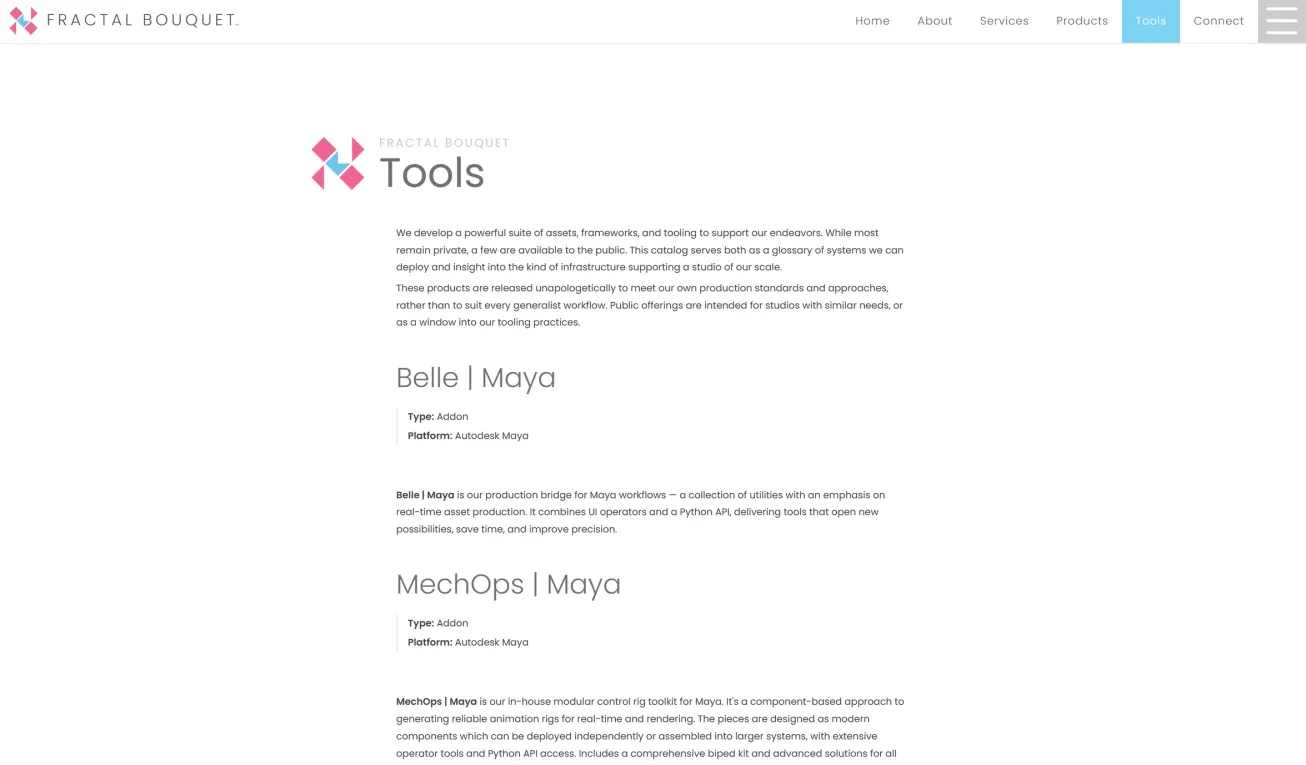
- Fractal Bouquet Web Tools Page, c. 2018
- Screenshot of Website
- Web Design by Alex Stevovich
I designed and developed the website for Fractal Bouquet, my studio platform focused on production arts, launched in 2018. Fractal Bouquet was established to give my game art, character work, special effects, and engine development a dedicated surface, partitioning this domain from my broader practice. The visual density and technical specificity of production arts work — game art, cinematics, shader development, 3D modeling, and engine systems — warranted its own context, distinct from the audiences and expectations of classical fine arts or general design clientele.
Scope of Work
- Website architecture and system design.
- Design and development of visual identity.
- Front-end development (HTML, CSS, JavaScript).
- Server-side application development (Node.js).
- Three.js integration for interactive 3D asset display.
- Development of proprietary image comparison slider for before/after and shader comparison display.
- Video playback and streaming integration for animation and cinematic content.
- Product pages for tools, scripts, addons, and plugins for DCC software.
- IP and franchise showcase development.
- Proprietary publishing platform development utilizing Marle.
- User engagement system including view counts and comment display.
- Responsive layout implementation.
- Search engine optimization and accessibility implementation, including structured metadata and semantic markup.
- Ongoing site maintenance and technical oversight.
Identity
The visual approach for Fractal Bouquet was deliberately restrained. Production arts work is visually dense by nature: game art, rendered cinematics, shader studies, and screen captures arrive with their own complex color palettes and compositional weight. Rather than introducing a competing visual identity, the site was built on a clean white foundation with neutral greyscale color fields, providing presentation surfaces that do not clash with the imagery they contain. The work leads entirely. The identity steps back to frame rather than compete.
Features
Portfolio Display
The site was designed to accommodate the complex presentational needs of production arts work across both visual and technical domains. Portfolio entries covered visual work including game art, character design, and cinematics, alongside technical work around game systems, engine rendering, shaders, and modeling production.
Three.js 3D Viewer
Three.js was integrated to support interactive 3D asset display directly within the browser, allowing models and production assets to be presented with full rotational interaction rather than as static renders.
Image Comparison Slider
A proprietary image comparison slider was developed to support before/after presentation of production work. A draggable divider allows viewers to reveal and compare two overlaid versions of the same image, suited to demonstrating shader changes, texture passes, lighting variations, and other production stages across the same asset.
Video and Streaming
Additional format support was implemented for animated movie playback, allowing animation and cinematic content to be presented directly on the site. Streaming integration was added to support larger content without requiring full download before playback.
Publishing Platform
A proprietary publishing platform was developed utilizing Marle, my custom data notation format and integration system, supporting original writing on production arts topics. Creative writing for the entertainment field was integrated into the same system alongside editorial content, all managed through a unified content model.
Products
Dedicated product pages were developed for tools, scripts, addons, and plugins developed for various DCC software packages. Personal franchises and IP offerings were presented separately, with display formats suited to entertainment and licensing contexts.
User Engagement
The site supported user engagement through comment display and view counts, providing an interactive layer to complement the publishing and portfolio content.
Responsive
A fully responsive layout was implemented to ensure consistent presentation across screen sizes and devices.
SEO (Search Engine Optimization)
Structured metadata, including Schema.org markup, was implemented across relevant page types. Semantic HTML, descriptive metadata, and logical pagination were used to support search indexing and discoverability. The site architecture was designed to support both human navigation and search engine crawlability.
Accessibility
The site was developed with attention to accessibility standards. Clear semantic structure, descriptive image metadata, and consistent navigation patterns were prioritized to ensure ease of use across devices and assistive technologies.
Technical Approach
The website is implemented as a Node.js server utilizing components of my proprietary Deep Frame architecture. Pages are rendered server-side through Lydio, my custom HTML rendering framework, utilizing server-side rendering over I/O rather than loading from disk. Content pages are rendered dynamically or rendered and cached depending on content type, supporting changing displays and user engagement without sacrificing performance.
This approach provides unified access to request context, data models, and rendering logic within a single execution layer, keeping the system cohesive and extensible without fragmenting responsibilities between client and server.
History
Fractal Bouquet launched in 2018 as a dedicated platform for my production arts practice. In 2022, the site was merged into alexstevovich.com as part of a consolidation of all studio divisions under a unified platform, reducing the maintenance overhead of running separate technology stacks across multiple business sites, and reflecting a shift toward presenting my practice as a unified polymathic body of work.