

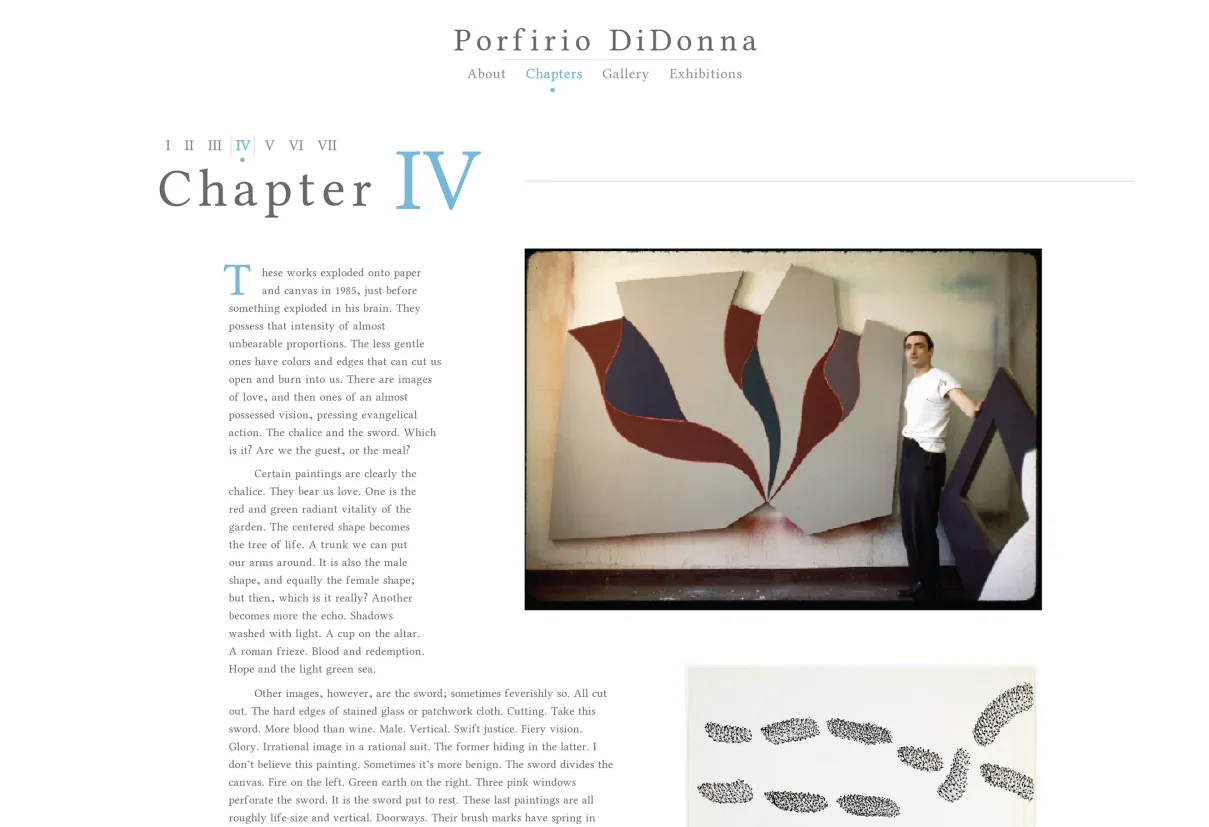
- Porfirio DiDonna Web Home Page, c. 2015
- Screenshot of Website
- Artwork by Porfirio DiDonna
- Web Design by Alex Stevovich
I developed the website for Porfirio DiDonna in collaboration with Nielsen Gallery, which managed the artist’s estate. The project functioned as both a scholarly presentation of DiDonna’s life and work and an evolving digital catalogue raisonné style archive.
The platform was structured around two integrated components: a long-form editorial presentation and a data-driven catalogue of works. Together, these systems created a hybrid publication model: part art book, part archival database.
Scope of Work
- Website architecture and system design.
- Front-end development (HTML, CSS, JavaScript).
- Server-side application development (PHP).
- Responsive layout implementation.
- Artist, artwork, and exhibition data structuring.
- Ongoing content updates and exhibition launches.
- Integration of promotional and exhibition design materials into the web system.
- Development of digital exhibition formats and virtual walkthrough concepts.
- Ongoing site maintenance and technical oversight.
Design Approach
The editorial portion of the site was organized into chapters, presenting DiDonna’s biography and career through a structured narrative format. A custom layout system was developed to support extended reading with inline images, captions, and sectional breaks, preserving the pacing and visual rhythm of a traditional art book within a web interface.
Careful attention was given to typography, spacing, and image scaling to ensure that the digital experience maintained the authority and clarity expected of a printed publication.
The second major component was a structured catalogue of works.
Data-Driven
The catalogue portion was implemented as a data-driven system allowing artworks to be added, updated, and refined as research expanded. Each work entry was modeled with relevant metadata and displayed in a clean gallery interface that supported both browsing and detailed viewing. The system was designed to remain extensible, accommodating future scholarship and archival growth without requiring structural redesign.
Navigation
Primary navigation was handled through a restrained header menu providing direct access to the major sections of the site.
Within the editorial portion, a dedicated chapter navigation system was developed. This allowed readers to move between sections of the essay in sequence while maintaining orientation within the broader structure of the publication. The goal was to support extended reading without fragmenting the experience.
SEO (Search Engine Optimization)
Structured metadata, including Schema.org markup, was implemented across relevant page types such as artist, artwork, and exhibition entries. Semantic HTML, descriptive metadata, and logical pagination were used to support search indexing and discoverability. The site architecture supported both human navigation and search engine crawlability.
Accessibility
The site was developed with attention to accessibility standards. Clear semantic structure, descriptive image metadata, and consistent navigation patterns were prioritized to ensure ease of use across devices and assistive technologies.
Technical Approach
The site was built using PHP with server-rendered HTML, which aligned with the operational needs and infrastructure of the gallery at the time.
Artwork Attribution
The artworks shown on the website are the work of Porfirio DiDonna and remain the property of the DiDonna estate and respective rights holders.