


In college, I once found myself enthusiastically explaining to a friend why I believed the production arts were superior to traditional fine art. These mediums unfolded across time and motion, carrying music, narrative, and performance within a single form. I argued that stacking these dimensions created a richer, more transcendent art form.
He listened, and said:
“So you’re going to invent the musical?”
It was a devastatingly simple response. I had no answer.
The synthesis I was describing already existed and it had not elevated it into an ultimate artistic state; it had stabilized into a form, a genre, a novelty with its own constraints. Adding more layers had not made it more art—only different art.
I was not alone in this dream. Walt Disney pursued a similar vision. He did not merely want to entertain. He sought legitimacy. He wanted animation to be taken seriously as an art form—capable of classical beauty, emotional depth, and expressive power. At the time, the emerging production arts—film, animation, and later television—were viewed by many artists as the highest possible artistic medium.
This is where the romanticism around Walt Disney’s ambition begins to crack. What did persist, however, was not a belief in limitless transcendence, but a powerful roadmap on how to build work that survives, resonates, and remains loved over time.
Perspective
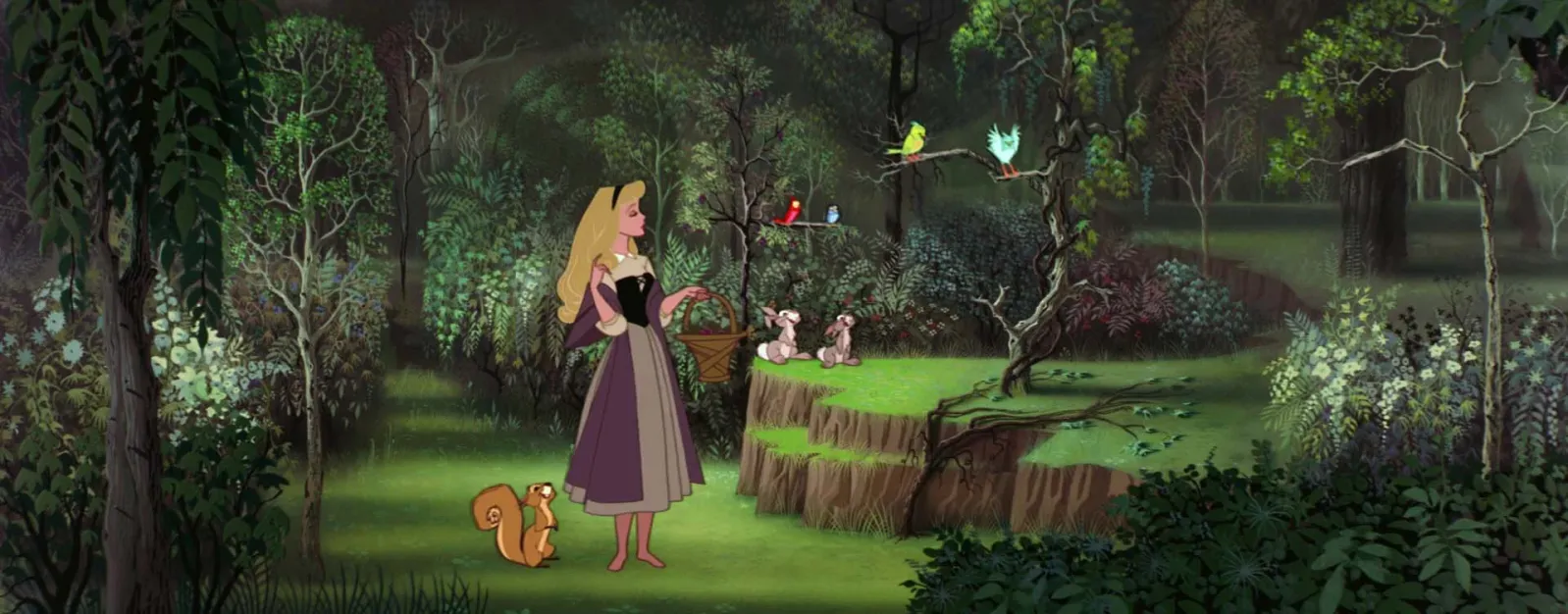
- Scene from Sleeping Beauty Animated Film by Disney, 1959
- Demonstrates the contrast in styles between the environment and the character art.
- © Rights held by the respective copyright holders
Sleeping Beauty is arguably Disney’s greatest masterpiece. But when someone says they love Sleeping Beauty, what are they actually responding to? The elegance and precision of the characters — or the dramatic, stylized world that surrounds them?
Before answering that, it’s worth briefly noting how Eyvind Earle came to be involved in the film. Disney selected him not as a conventional production designer, but as a fine artist — someone capable of carrying Walt Disney’s ambition to elevate animation beyond entertainment and into an art form. That decision created tension throughout production. Earle’s visual language was uncompromising, clearly seen in the background artwork that he specialized in.
Both impulses are visible in the image above. Aurora herself is rendered with tight line work, soft forms, and bright, controlled color fields. Her design is clean, legible, and emotionally open. The surrounding landscape operates differently: structured geometry, deep shadow, and carefully composed space create a world that feels formal, theatrical, and visually weighty.
Gradient of Appeal
All of Disney’s twentieth-century 2D animation output represents extraordinary technical achievement. Each film is a marvel of craft, labor, and coordination.
From the 1950s onward, a gradual shift occurred. With each successive generation, the aesthetic softened — becoming more accessible, more emotionally legible, and more tightly optimized around appeal. The severity and formal tension that characterized Walt Disney’s most ambitious projects gave way to designs that traveled more easily across audiences and markets.
Fidelity
As production arts evolved alongside computing, consumer language failed to evolve with it. Phrases like “good graphics” became shorthand for visual realism, training audiences to equate artistic progress with increased fidelity. “More real” came to be understood as inherently better, as if realism itself were an artistic endpoint rather than one aesthetic choice among many.
What this language obscures is that stylization is not a shortcut — it is often the harder path. Realistic pipelines benefit from physically based defaults that approximate the real world automatically. Stylized work requires the opposite: deliberate abstraction, authored light, controlled color, and engineered restraint layered on top of complex systems not designed for it.
Audience
Production art does not exist in isolation. Audience expectations impose practical constraints that shape how work is presented, interpreted, and received. This section outlines the most prominent of these pressures in the production arts.
Sanitization
A lot of art is under institutional pressure, infographics, corporate illustration, public-facing visual systems, and even high-end brand work. The goal is communication without friction. Ambiguity is treated as failure. Identity is treated as risk.
Appeal
Appeal describes an objective quality of art: a set of visual traits associated with youth, cuteness, vitality, and emotional safety. It is a visual language optimized for immediate legibility and broad attractiveness. Over time, this language has become dominant across stylized popular media. It follows identifiable criteria. It can be graded, optimized, and reproduced.
A simple way to understand appeal is to imagine an illustrated character exactly as drawn, but standing next to you as a physical presence. Would you feel comfortable, or terrified? Appeal operates at this immediate, pre-cognitive level.
The danger of appeal is that it is so effective it risks assimilating everything around it. Like a species without natural predators. Highly appealing forms — anime-derived character design, Ghibli-inspired landscapes, Pokémon-like softness — represent some of the most refined expressions of appeal ever developed. They are beautiful, welcoming, and deeply loved. Precisely because of this, they have become difficult to resist.
Production
Internally, modern production must conform to the limitations of the state of the art. These forces are rarely visible to audiences, yet they exert constant pressure. This section outlines a few production issues which force compromises into all productions.
Identity
A major problem with modern realistic productions is that audiences struggle to distinguish them from one another. Many projects rely on the same engines, rendering models, lighting solutions, and often even the same asset libraries. Stylized productions face the same issue. Highly appealing visual languages tend to dominate.
When a style becomes ubiquitous across properties, it stops signaling creative intent and starts signaling genre compliance. At this point, some audiences disengage.
Foreground vs. Background
Characters are privileged. They are designed to be read instantly, merchandised, animated, and loved. Backgrounds, environments, and spatial composition must support this without competing for attention. The result is a persistent asymmetry: figures are expressive and stylized, while worlds are subdued, softened, or simplified to avoid visual conflict. Balancing the environment is always a challenge and modern pipelines intensify this.
Lit vs. Cel-Shaded (Unlit)
Environments must be lit to convey space, depth, and material coherence. Characters — especially in stylized work — often benefit from flatter, more controlled shading.
This tension is visible in the previously shown image of Sleeping Beauty. Aurora is only line art and solid colors, carrying no shading at all, yet exists within a highly shaded, formally composed world. In 3D production, this problem becomes far more severe, as almost no light altering stylization is viable in the shading of an environment due to intrinsic limitations of rendering.
Ubiquity of Physically Based Rendering
Modern 3D production assumes the image should behave like a photograph. Light is simulated, and surfaces are expected to react realistically to it. This approach is efficient and reliable for realism, but deeply hostile to stylization.
Stylized work wants the opposite. It wants light to be authored, color to carry emotion, and surfaces to feel designed rather than physically accurate. In modern 3D production, achieving this is always a technical feat of engineering. Even then, only a very narrow bandwidth of stylistic visions can be adapted successfully. Most stylistic approaches are simply unviable within current state of the art 3D.
AI may be capable of solving this in the near future — particularly in its ability to generate non-photorealistic imagery unconstrained by physical simulation — but that possibility comes with its own complications and falls outside the scope of this article.
Industry
As companies scale, financial risk reduction becomes the dominant priority. Decisions are guided by analytics, projections, and proven pathways to growth.
This process emerges naturally as organizations grow beyond the scale where individual voices can meaningfully steer direction. The system becomes too large to respond to taste, intuition, or singular vision.
Cogs of Enterprise
Early production art required excellence in every seat. A Disney feature in the 1950s was built by hundreds of S-tier artists, each required to bring exceptional artistic skill. This was needed at every stage of production.
As production scales, enterprise logic replaces that model. Work is broken down into consistent steps and production begins to resemble a conveyor belt.
This shift is not unique to entertainment. In games and software, it explains why Unreal Engine is increasingly favored over bespoke in-house engines. It reduces dependency on rare specialists and allows studios to plug in interchangeable labor. Contrast this with earlier eras — id Software, Richard Garriott, garage-scale development — where vision, authorship, and risk were inseparable. Those environments were fragile and failure-prone, but they allowed singular voices to exist. Modern enterprise prioritizes continuity and scalability instead. The result is efficiency at the cost of authorship.
Art Components
In large-scale production, art is rarely allowed to appear as art. Individual artists pour extraordinary skill and care into assets, scenes, systems, and ideas, yet their contributions are encountered only as components of a product. From the outside, authorship becomes faceless.
Even when a recognizable figure emerges — a Kojima, a Miyazaki, a rock-star creative — engagement often is celebrity rather than sustained artistic dialogue grounded in the work itself. The art remains present everywhere, but is almost never focused on.
Institutions & Masses
There are countless examples of artists only being recognized after death, and of those recognized in life, most require substantial institutional backing. Any serious artistic career involves a prolonged negotiation between the value of the work itself and the value society assigns to it. This negotiation does not occur in isolation. It unfolds between three forces: the artist’s vision, the institutions that confer legitimacy, and the public whose attention sustains visibility.
Modern media ecosystems intensify this tension. They are highly dopaminergic, optimized for immediacy, repetition, and emotional capture. This does not imply that audiences are wrong, shallow, or incapable of depth. It describes the conditions under which attention now operates. What rises, what endures, and what is discussed are shaped as much by structural pressure as by merit.
The criteria by which art is judged — across fine art and production media alike — are therefore often misaligned with its deeper value. This section examines how institutional authority and mass attention, acting together and in opposition, exert pressure on art, reshaping not only what succeeds, but what is allowed to exist at all.
Denial
Alongside this closure exists a pronounced skepticism within modern academia toward production media, particularly in the West. Film, games, animation, and popular illustration are frequently treated as trivial, juvenile, or culturally beneath sustained critical engagement. Large portions of contemporary lived culture now occur within production media. To refuse to engage with it critically abandons the field entirely. This withdrawal might explain why many younger generations feel alienated from institutional fine art.
Patronage
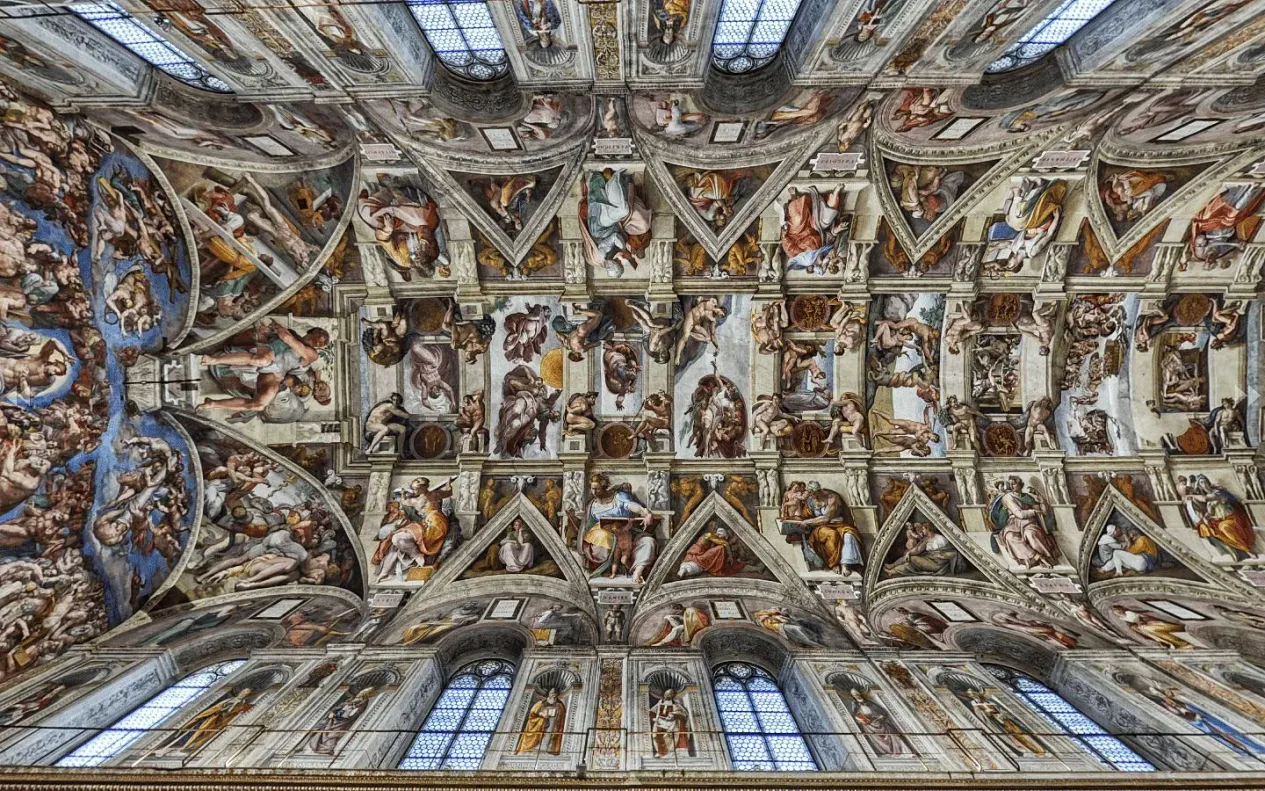
- Michelangelo, Sistine Chapel ceiling, 1508–1512
- Vatican City, Rome
The Sistine Chapel did not exist because it reflected the taste of the masses. It existed because Pope Julius II acted as a patron and mandated conditions where uncompromising work could exist, selecting Michelangelo not for accessibility or popularity, but for his capacity to execute something severe, ambitious, and culturally transcendent. That same structure appears at Disney. Walt Disney did not choose Eyvind Earle because his work was safe or broadly appealing, but because it could elevate the medium itself. In both cases, brilliance was not discovered by popular taste — it was grasped by an institution willing to absorb risk in pursuit of transcendence.
Success is Failure
Good art is rarely a continuous journey of praise or affirmation. It more often has no clear paths, no validation, and its continuation depends entirely on conviction. Whether this is called integrity or self-delusion is often decided long after, or simply forgotten, regardless of caliber.
Visual Mythology
In all production settings, I advocate for maintaining what I’ve described as a visual mythology: a fine-arts–driven creative north star that operates alongside production.
This is not conventional art direction, and it is not conventional concept art. It's explicitly at least one highly visionary, fine-arts, layer. The role exists to articulate a deeper ambition for the project.
In practice, this often takes the form of elevating at least one artist with a strong fine-arts sensibility whose work resonates with the project’s intent. Their output may exceed the limits of the pipeline. It may never appear verbatim in the final product. The work exists to expand the project’s imaginative space.
When effective, this influence is not confined to visuals. It frequently permeates music, narrative tone, cinematography, pacing, and world-building.
Historically, the most enduring production institutions deployed this strategy. The resulting projects were not only successful in a commercial sense — they became culturally loved, long-lived, and identity-defining for the studios that produced them.
Disney
During its most artistically ambitious period, Disney deliberately elevated fine-arts perspectives. The studio accepted aesthetic tension as a feature rather than a flaw, and the resulting works are widely regarded as the era’s masterpieces — distinguished by a level of cultural presence and artistic authority that has rarely been matched.
Mary Blair
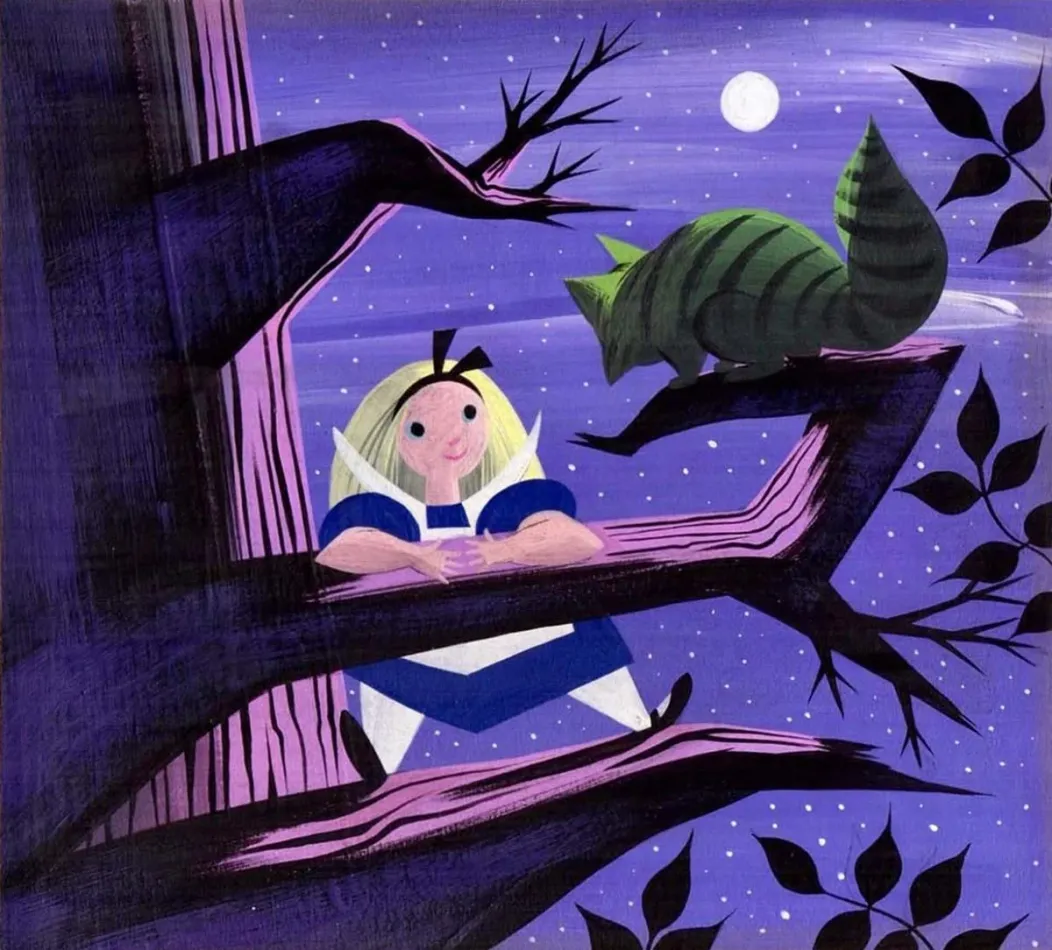
- Mary Blair, Concept Art for Alice in Wonderland, 1951
- Gouache on board
- Demonstrating one of the styles of Mary Blair
- © Rights held by the respective copyright holders
Mary Blair played a defining role in shaping Disney’s visual language during the studio’s mid-century period on projects such as Alice in Wonderland. She introduced bold color theory, graphic abstraction, and modernist composition, favoring emotional tone and spatial rhythm over literal representation. Her work expanded the expressive range of animated worlds by treating color and form as primary storytelling tools.
Eyvind Earle
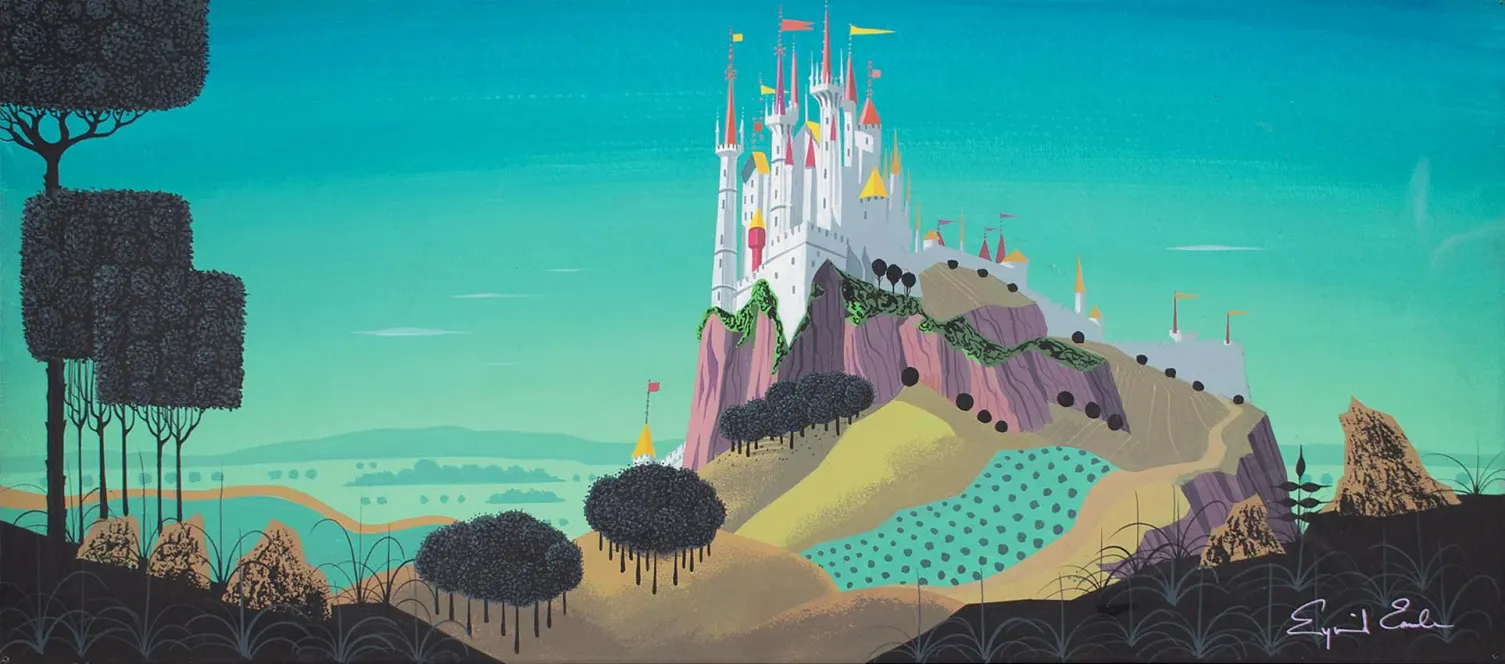
- Evyind Earle, Concept Art for Sleeping Beauty, 1959
- Gouache on board
- Demonstrating one of the styles of Eyvind Earle.
- © Rights held by the respective copyright holders
Mentioned prior Eyvind Earle who elevated by Disney into a visual leadership role for the production of Sleeping Beauty. His work is characterized by severe geometry, flattened perspective, strong graphic contrast, and a disciplined use of light and shadow derived from medieval and modernist traditions. This approach introduced significant tension and challenged conventions. Yet the film’s lasting cultural impact and visual distinction speak directly to his success.
Square
In interactive production, Square provides a parallel example. During its formative years, the studio consistently paired each major franchise with a distinct fine-arts illustrator whose work operated as a unifying aesthetic presence across the project. These artists were not limited to internal concept development; their illustrations shaped promotional material, box art, manuals, advertising, and frequently informed world tone, visual motifs, and thematic identity.
Each mainline franchise carried its own artistic voice in this role. Final Fantasy was associated with Yoshitaka Amano, Seiken Densetsu (Mana) with Hiro Isono, and Chrono Trigger with Akira Toriyama. Together, these artists established parallel visual mythologies that extended beyond individual titles and helped define the studio’s broader cultural identity.
I will focus here on Amano, as he was selected to define the studio’s flagship series during its most formative period.
Yoshitaka Amano
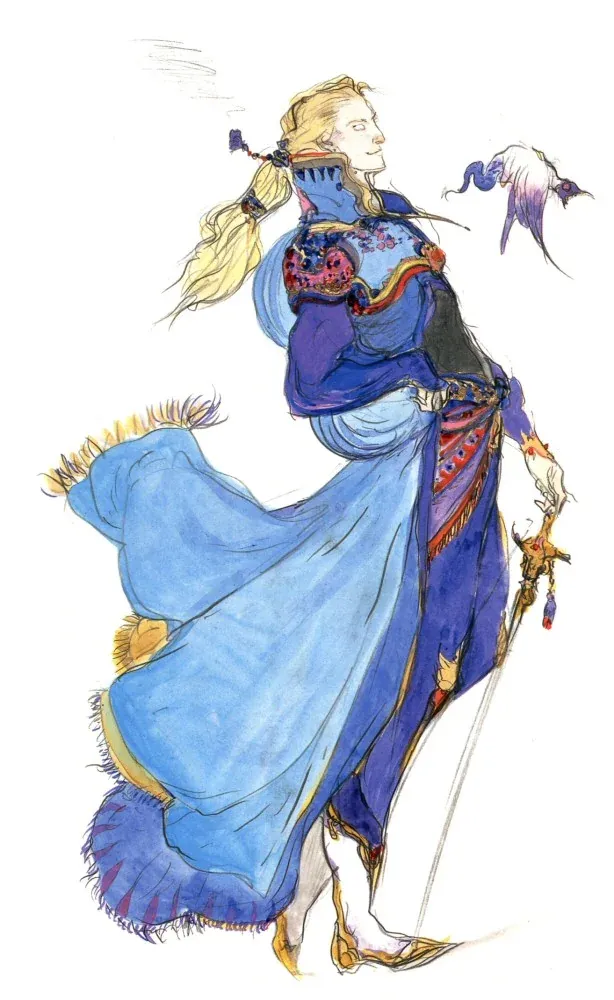
- Yoshitaka Amano, Concept Art for Final Fantasy VI Edgar, c. 1994
- Demonstrating the style of the artist
- © Rights held by the respective copyright holders
Amano’s role extended beyond illustration into character design, vehicles, architectural concepts, and visual motifs that were adapted directly into the games themselves. His work drew heavily from classical illustration, surrealism, and fashion-influenced line work, producing imagery that was ornate, ethereal, and deliberately ambiguous.
While this aesthetic did not always align cleanly with contemporary expectations of interactive media—particularly for younger audiences—it became a defining standard over time. Amano’s imagery established a visual mythology that outlived specific mechanics or technical constraints, shaping not only the identity of the franchise, but contributing to the long-term artistic perception of the studio itself.
Deployment
At a glance, this structure can resemble auteur theory — but it is fundamentally different. Auteur theory assumes a singular creative authority. Visual mythology assumes patronage and humility.
What is required is not a lone visionary, but a constellation of roles: a patron willing to risk time or money in pursuit of something culturally larger; leadership capable of recognizing its own blind spots; and at least one fine-arts voice operating outside production logic, protected from optimization pressure.
Leadership, in this model, is not authorship but stewardship. The failure mode is not disagreement, but hubris: mistaking efficiency for vision, or control for coherence.
When visual mythology is present, production retains identity under pressure. When it is absent, work collapses inward toward optimization — functional, successful, and forgettable.
Interactive
Interactive media suffers from a long standing literalism. Imagine a world where books had been labeled “page games.” In such a world, pages would be expected to host only puzzles — Sudoku, crosswords, simple challenges — reading would be regarded as a trivial pastime for children, and no serious creative would even consider putting literature into one. This is, in effect, what happened to interactive media.
The word "game" carries enormous cultural baggage, particularly in the West. It has framed expectations so narrowly that confusion now permeates every layer of the medium — critics, institutions, consumers, and even development studios themselves. An entire expressive form has been persistently misread through the lens of a single, overloaded word.
Consumer and Influencer Narrative
A dominant consumer narrative insists that visuals, tone, and atmosphere are secondary — or even irrelevant — so long as the underlying mechanics are compelling. This is misguided and not supported by observable behavior.
Audiences consistently attach themselves to worlds, characters, music, and imagery. They remember places more than systems. They return to tone, atmosphere, and visual identity long after specific mechanics have aged out of relevance. Control schemes, balance models, and skill ceilings date quickly; aesthetic memory does not.
Systems and Games
When a project is designed purely as a system to be mastered, visual and artistic concerns legitimately recede. In those cases, the player’s relationship to the work becomes instrumental rather than expressive. Engagement is sustained through repetition, optimization, and reward — a closed loop that can be effective, but rarely enduring.
Even when such projects feature strong art, the underlying structure encourages players to disregard it. Attention shifts away from world and meaning toward efficiency and outcome.
There are, of course, works that are intentionally designed as literal games or competitive challenges — particularly in player-versus-player contexts. These follow a different set of priorities entirely. That domain has its own internal logic, and it is outside the scope of this article.
The Just of Art
To conclude this theory I have to draw a line to say how I define art. Some things cannot survive endless deconstruction. Like morality, they require a line to be drawn — not because the line is provable, but because meaning itself depends on having one.
Financial systems
Earnings prove only what earns. They do not prove what is good, what matters, or what has meaning. Within a system that values only financial extraction, success simply indicates efficiency at extracting resources. If this were sufficient, there would be no reason for art to exist at all. We would abandon creative work entirely in favor of brokerage, arbitrage, and financial engineering — endlessly reshuffling systems to materialize money from money.
What is Art?
I cannot define what art is. I can only gesture toward it. It is a transcendent, intangible factor that resists reduction, and yet its existence is undeniable. We see its proof in the marks it leaves across time — in inspiration, awe, beauty, and the enrichment of human life. Art persists where extraction does not. It leaves behind more than outcomes of power or accumulation.
Practicality of Art
The world is not structured to prioritize an ideal of art. We all must make a living. Many real-world projects are not undertaken to make art, but to shoulder responsibility, manage risk, and ensure that high-stakes products succeed. There is no prescription to only make art, nor a clear formula for balancing passion and profit.
History can be inferred to show that institutions which fight to include art — even briefly — are often the ones that rise above mere success.
General Strategy
Thank you for reading my analysis of the state of production arts, and the modern challenges it faces. I will conclude directly stating how I have come to view the appropriate tactics to solve these problems.
What follows is a prescriptive framework intended to apply broadly across most production contexts. It is not a universal solution, and it may not align perfectly with the specific constraints or goals of every project.
Time & Money
In most professional contexts a primary resource is money, but in solo work, small teams, or early-stage studios, it is often time — unpaid time, deferred time, or time willingly risked without guarantee of return. Regardless of scale, this resource defines what can be risked, how long uncertainty can be tolerated, and how much artistic ambition can realistically be carried.
Appeal Arms-Race
You must decisively win the appeal arms race. Characters need to be immediately inviting — lovable, shiny, cosplayable, waifuable. They must support attachment at a glance. In contemporary consumer-facing media, opting out of appeal is rarely an option.
Appeal functions as the delivery mechanism. Art is not created to admire our own integrity. It is created to be encountered. Appeal is the interface through which a project enters public consciousness — the structure that allows more demanding ideas to pass through a commercial form without being rejected outright.
Visionary Art
In all production settings, I advocate for what I’ve described as visual mythology — a fine-arts–driven art influence operating alongside production. This role does not need to be production-viable, optimized, or even directly executable. Its value is inspirational rather than logistical.
I would actively seek out a visionary fine-arts perspective capable of articulating a transcendent visual sensibility for the project or franchise. This voice exists to inform mood, tone, composition, and aesthetic ambition — not to manage assets or dictate implementation.
It is the responsibility of leadership, at the director level, to foster an environment where this voice can meaningfully guide production. How prominently it manifests depends on constraints. In some projects it may visibly define the work; in others it may surface only subtly. But even in highly optimized or risk-averse settings, I believe at least one such perspective should be present and protected.
When this role exists, production retains identity under pressure. When it does not, work tends to resolve entirely toward optimization.
Leadership
At production scale, leadership is not a matter of taste alone. The surface area of decisions becomes too large for any single individual to fully comprehend. No director, no matter how talented, can see every dimension clearly. The defining skill of leadership is not control, but the ability to recognize one’s own blind spots.
This is not delegation in the managerial sense. It is the discipline of discovering and protecting champions — individuals whose vision, taste, or sensitivity exceeds the leader’s own in specific domains. True leadership requires the humility to accept that the most important voice on a project may not be the director’s, and the authority to defend that voice when it conflicts with convenience, consensus, or optimization.
Strong leaders do not attempt to be the best in every room. They build rooms where better specialists can exist, and ensure their work survives the machinery around it. Hubris, not disagreement, is what collapses vision at scale.
Interactive
For interactive works positioned as visual or narrative endeavors, I advocate treating gameplay as a compelling illusion — a mechanism that serves agency, control, and presence within a world. Gameplay should support the experience, not subsume it.
In practice, this places particular importance on movement and camera. Direct control should feel intentional, elegant, and responsive. Smooth, readable motion matters more than spectacle. Expressive movement sustains immersion in ways mechanical complexity alone cannot.
If a project is designed as a literal game — centered on mastery, competition, or challenge — it requires a different set of priorities and dedicated specialists focused on those systems. That domain follows its own internal logic and falls outside the scope of this theory.
Practicality
Art does not exist outside material reality. Projects have limits: time, money, investment, obligation. These constraints are not moral failures; they are conditions. Choosing to pursue art within a production context means accepting responsibility not only for vision, but for the risks that vision creates.
Not every project is meant to be art, and not every project can afford to become one. The decision to take that risk often conflicts with incentives designed to minimize uncertainty and protect return. When other people’s livelihoods, capital, or trust are involved, ambition must be weighed against consequence.
There is no integrity in ignoring these realities. The ethical task is to understand them clearly: what has been promised, what is at stake, and who bears the cost of failure. Making art under constraint means choosing where risk is justified, where compromise is necessary, and where ambition must be restrained.
Signing off
I appreciate you making it to the end, and I hope these insights are useful in helping shortcut some of the harder lessons that production inevitably teaches. This article is informed by practical experience across many facets of the production arts, alongside long-form study of the field and its history.