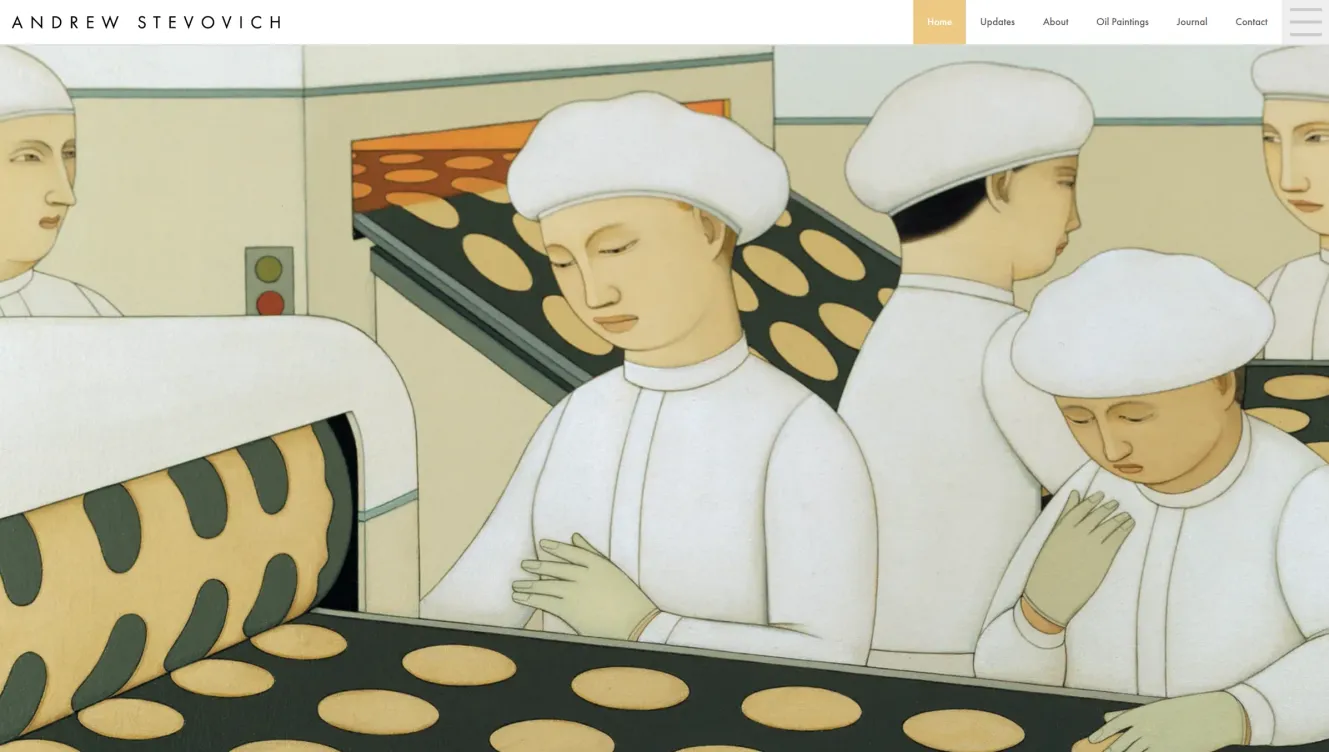
- Andrew Stevovich Web Home Page, c. 2025
- Screenshot of Website
- Artwork by Andrew Stevovich
- Web Design by Alex Stevovich
I designed and developed the website for Andrew Stevovich, a painter whose career spans nearly five decades and encompasses close to a thousand paintings alongside a far larger body of drawings, pastels, prints, watercolors, and works that resist easy categorization. The site launched in 2023 as the third generation of his web presence and the most technically and editorially ambitious, conceived not as a portfolio but as a catalogue raisonné: a comprehensive, relational, data-driven record of an entire artistic life.
Andrew Stevovich is a significant figure in contemporary realist painting with an international exhibition record, representation by major galleries, and a presence in major institutional and private collections. The professional expectations for this project were not those of a personal site. They were those of a serious institutional archive, and the technical and design work was held to that standard throughout.
I am his son. This project is one of the most personally important things I have built.
Scope of Work
The following is an abbreviated scope of work. A full itemized scope is listed at the conclusion of this article.
- Website architecture and systems design.
- Visual identity and design.
- Front-end development (HTML, CSS, JavaScript).
- Back-end development (Node.js, Fastify).
- Catalogue raisonné data architecture and schema design.
- Corpus development, data transcription, and automation tooling.
- Python tooling for corpus management and image processing.
- Build system development including CSS and JavaScript bundling and optimization.
- AI audit system development.
- Ongoing maintenance and technical oversight.
Purpose and Approach
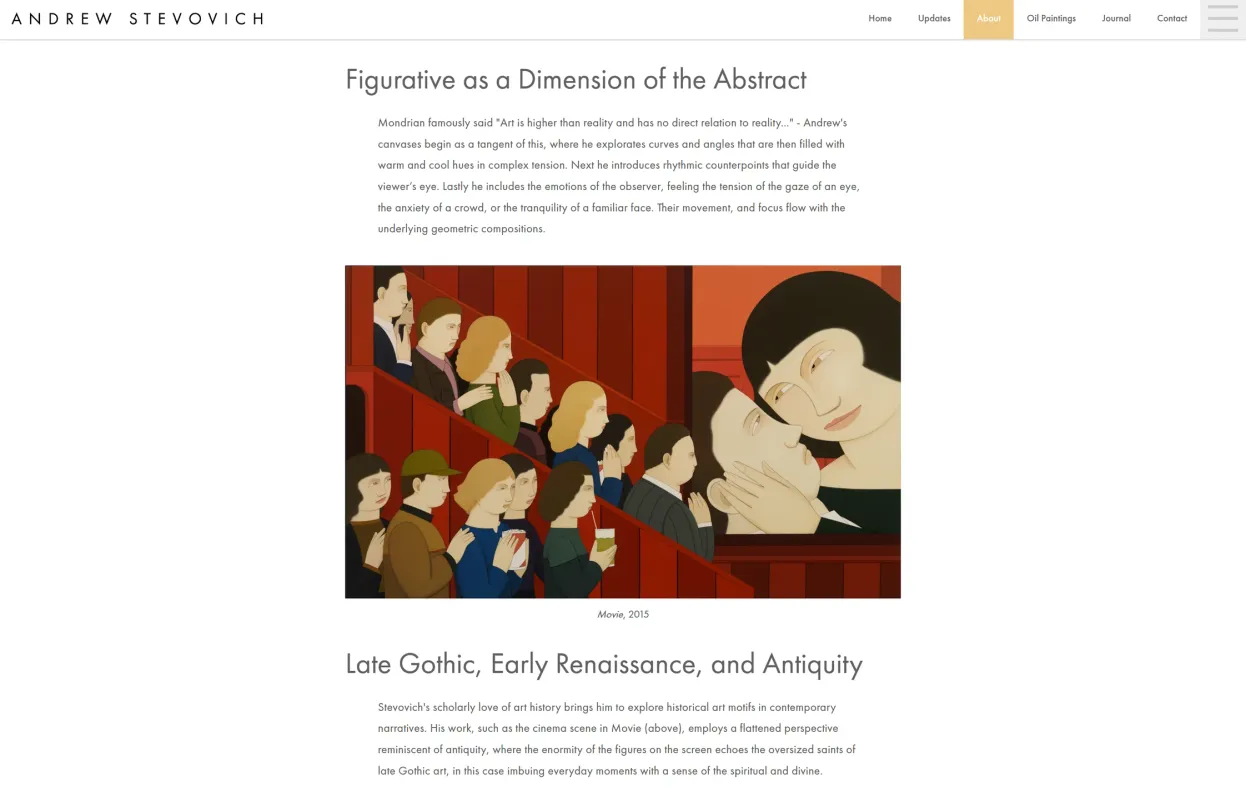
- Andrew Stevovich Web About Page, c. 2025
- Screenshot of Website
- Artwork by Andrew Stevovich
- Web Design by Alex Stevovich
The goal of this redesign was to take on a genuinely comprehensive presentation of Andrew Stevovich's career, updating the technology, features, and ambition of the prior generation to a modern standard while building something capable of lasting and growing for as long as the work continues to exist. The site needed to hold an enormous amount of information and hold it well, presenting it with the visual clarity and breathing room appropriate to serious painting without the data ever becoming a burden to the viewer.
The design language is deliberately museum-esque. Clean, spacious layouts prioritize the paintings at practical large sizes. Images are dynamically sized to always present optimally based on orientation. The work is given room to exist on the page without competition from the interface around it.
Catalogue Raisonné Data Architecture
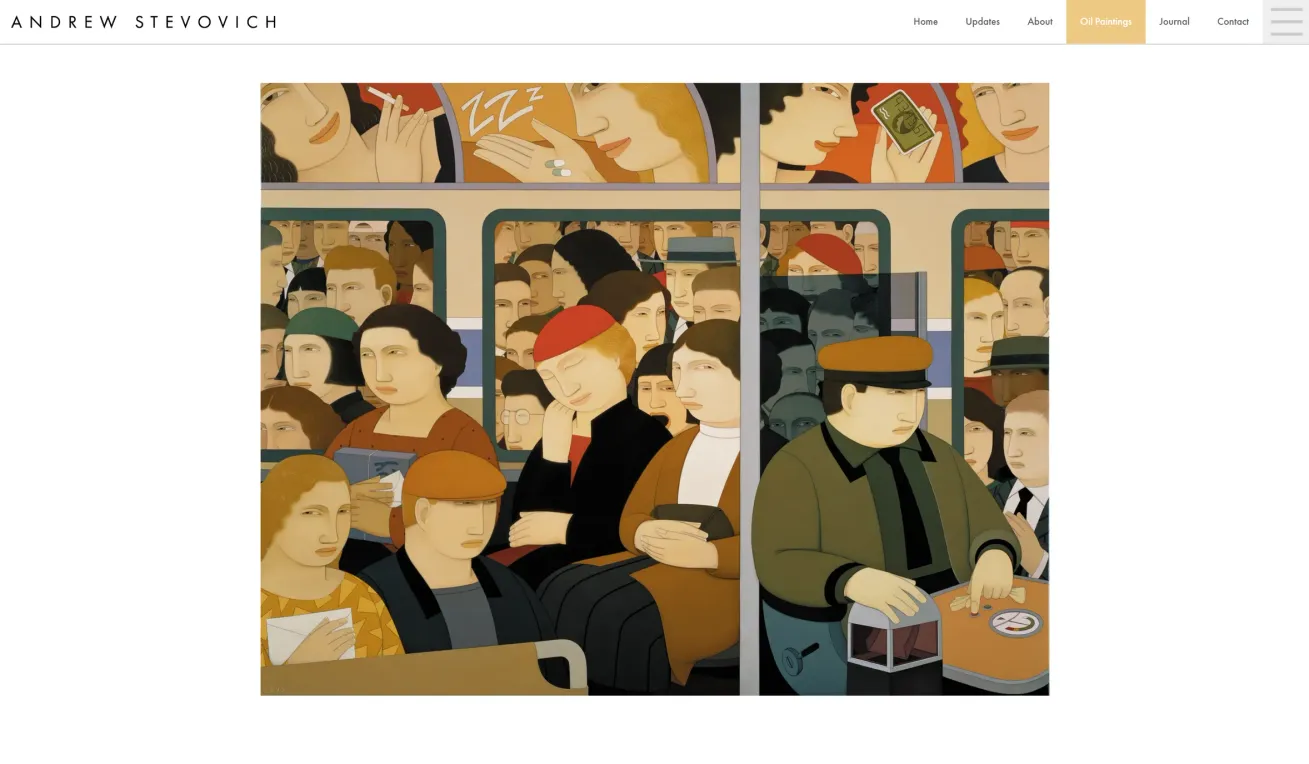
- Andrew Stevovich Web Artwork Page featuring Local Switch, c. 2025
- Screenshot of Website
- Artwork by Andrew Stevovich
- Web Design by Alex Stevovich
The data architecture was one of the most substantial undertakings of the project. Designing a schema capable of holding the full complexity of a painter's career at this scale, across media types, periods, provenance chains, exhibition histories, publication records, and relational connections between works, required careful structural thinking. The schema was designed as part of a larger initiative into catalogue raisonné data architecture that has since become its own dedicated project, exploring the storage of artist corpus data free of any specific layout, in long-living, transformable structured data formats.
For this site the corpus was built from a combination of manual transcription, data processed from existing Google Sheets and Excel records through custom tooling, and automation strategies developed to handle the ongoing maintenance and growth of the archive. Python tooling was developed for corpus management, image processing, and color analysis. The data architecture and the website are treated as separate concerns: the corpus is the authoritative record, and the website is one layout expression of it.
Each artwork record is comprehensive. Fields include medium, glaze, varnish, signature location, dates, provenance, color data, perceptual color analysis, thematic categorization, and more. The site cross-references this data relationally: artworks display which reviews discussed them, which exhibitions featured them, which publications included them. Drawings show the paintings they were studies for. Reviews reference the works they address. Everything is connected.
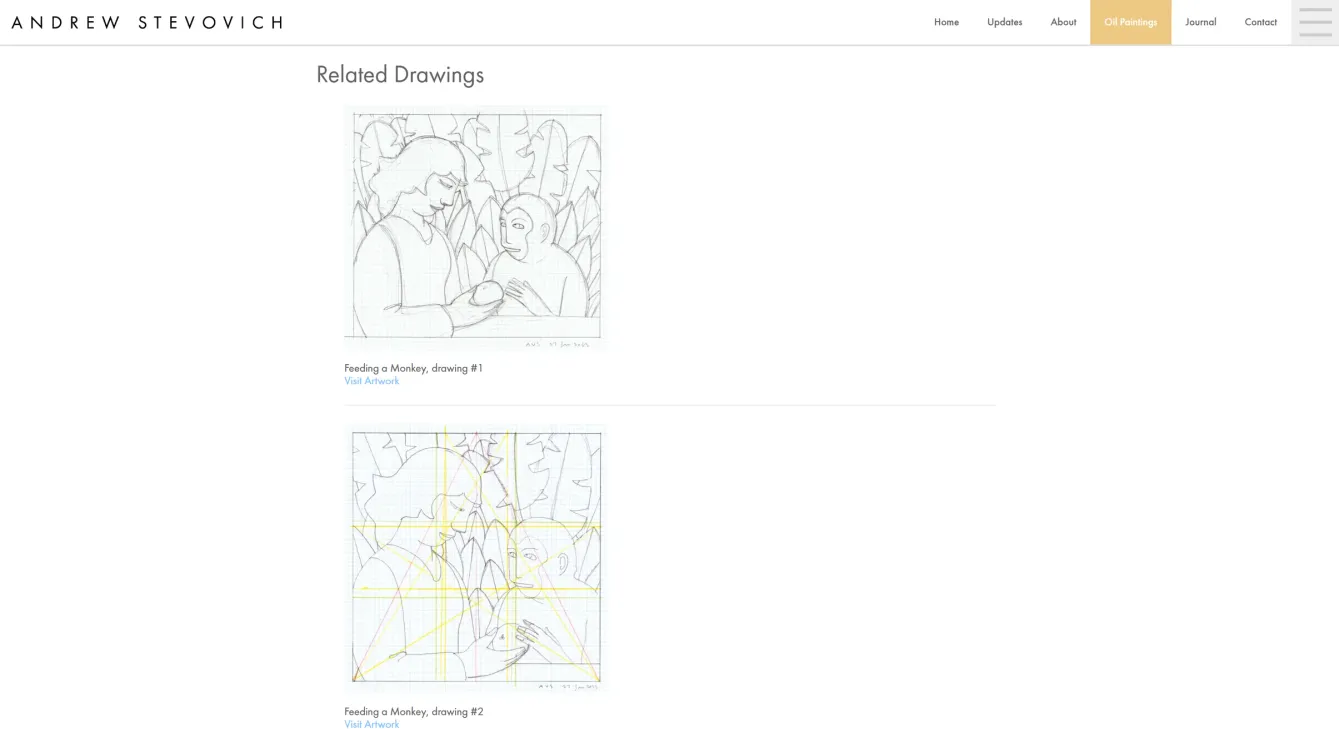
- Andrew Stevovich Web, Demonstrating Related Drawings, c. 2025
- Screenshot of Website
- Artwork by Andrew Stevovich
- Web Design by Alex Stevovich
Color Analysis System
A dedicated build step was developed to analyze artwork imagery for color data. This process extracts dominant color, average color, and color theme information from each work, combining direct mathematical color analysis with perceptual color interpretation leveraging machine learning to handle the nuance of how color is experienced rather than simply measured. This color data is incorporated into the site's records and used to provide color context and enable color-based sorting and exploration of the archive.
Identity and Navigation
The site features elegant side menu navigation designed to function consistently across desktop and mobile. Settings accessible from the main menu include light and dark mode toggle, metric and imperial unit toggle for caption dimension displays, and an archival mode which surfaces substantially more detailed data fields for each artwork, suited to researchers and serious collectors.
The home page features a screen-size-responsive slideshow that gracefully introduces and transitions through paintings in random sequential order, selecting images appropriate to the viewer's screen ratio. The effect is immediate and considered, establishing the quality and range of the work before the visitor has navigated anywhere.
Display and Exploration
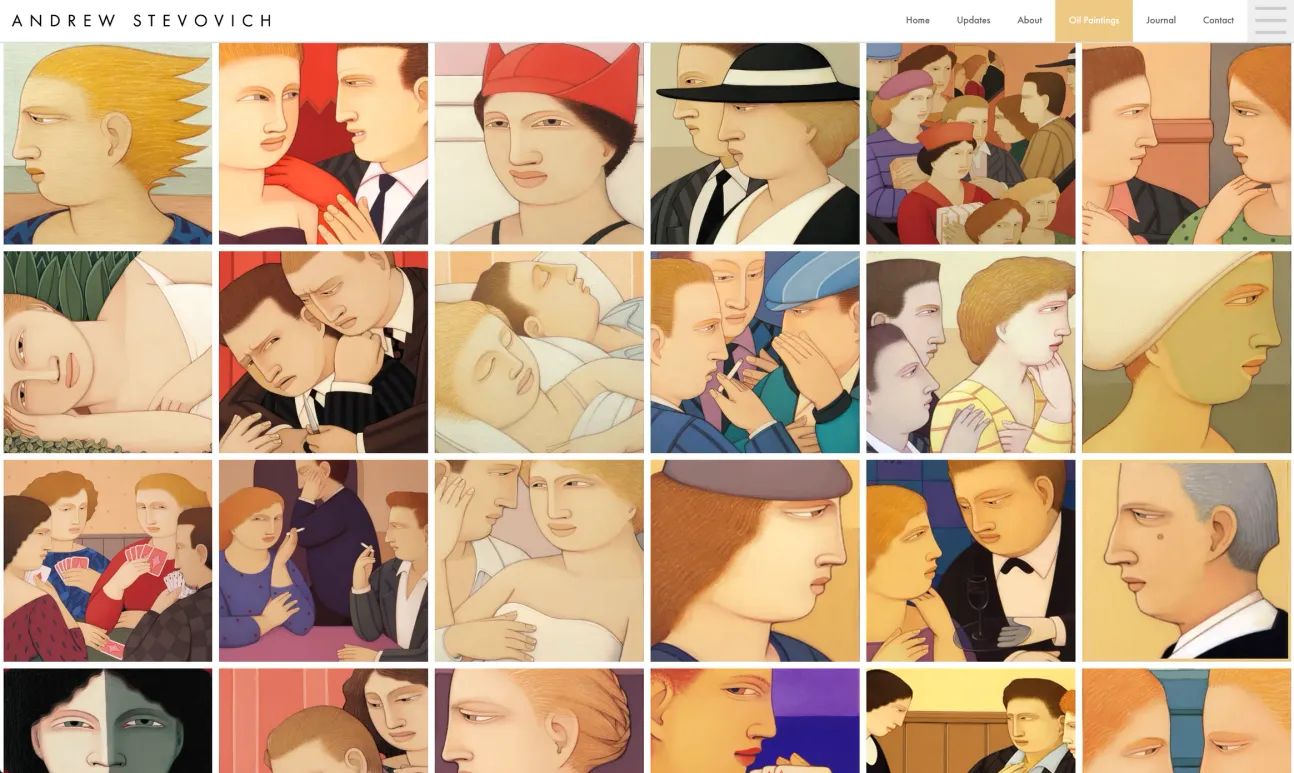
- Andrew Stevovich Web Oil Paintings Page, c. 2025
- Screenshot of Website
- Artwork by Andrew Stevovich
- Web Design by Alex Stevovich
Artwork is presented through two complementary views. Gallery pages present work as beautiful, explorable grid displays that fill the screen with images, each selectable for individual viewing. List view pages present the same work as plainly captioned entries for methodical browsing. Both views serve different modes of engagement with the archive and are available across the major categories of work.
The custom image solution dynamically sizes images based on orientation to ensure optimal presentation across the large grid flows that characterize the gallery displays. Artwork detail pages are rich with relational data, contextual information, and the full depth of the catalogue record.
Architecture and Scale
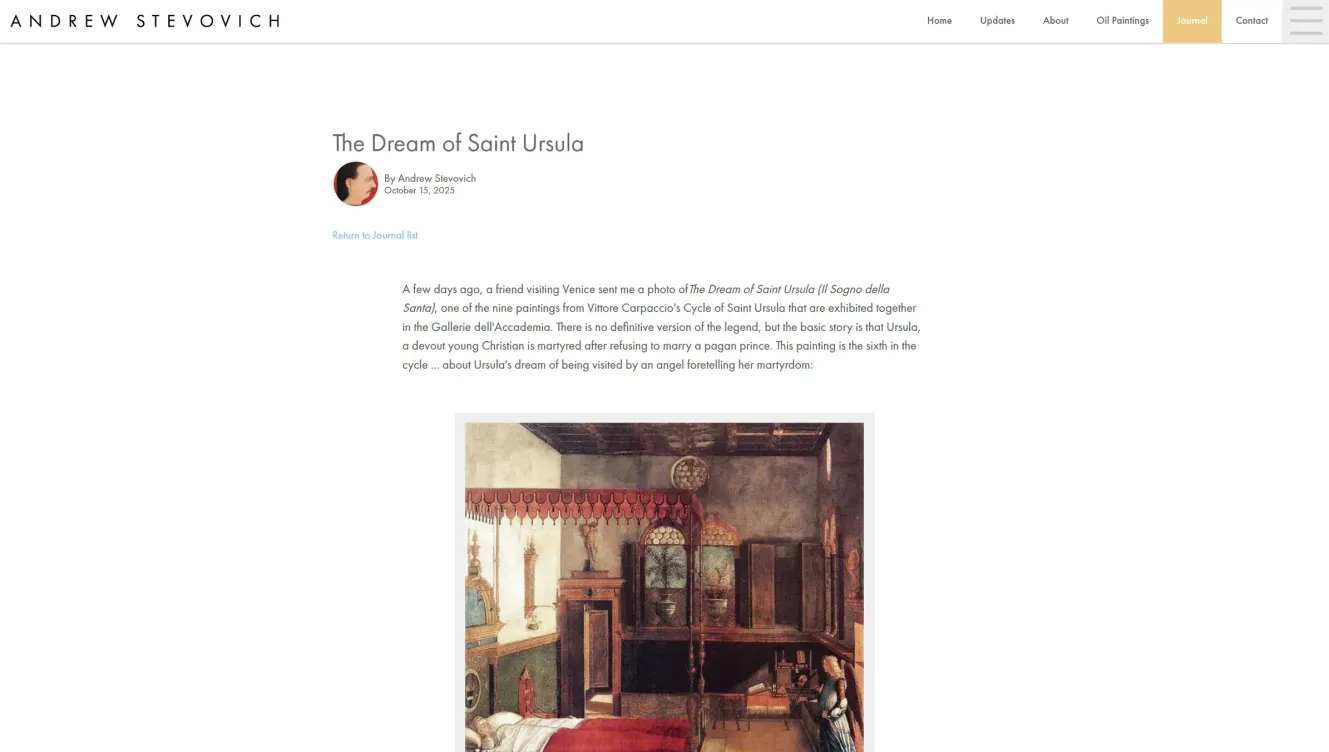
- Andrew Stevovich Web Journal Page, c. 2025
- Screenshot of Website
- Artwork by Andrew Stevovich
- Web Design by Alex Stevovich
The site contains thousands of pages and was architected around O(1) scalability requirements consistent with a lifetime archive. Adding content carries no escalating build cost and no performance degradation. Updates target specific articles or content rather than requiring full rebuilds of the archive.
Pages are rendered at runtime through Lydio, my custom HTML rendering framework, operating over I/O rather than loading from disk. For large indexed content types such as artwork listings, reviews, and publications, Lydio templates render against Marle JSON documents at runtime, producing individual pages from single templates without any HTML build step. The site hot reloads from a data seed, assembling all relational links whenever the data file changes.
The server is built on Fastify, configured primarily as a static server, with a custom image router designed to serve optimally sized images for the site's large grid displays. Deep Frame provides authentication, error handling, security, and performance infrastructure.
Systems and Infrastructure
Legacy and Redirect Handling
As the third generation of this site, an extensive body of old URLs and deprecated pages required careful handling. Server-level handlers were implemented for all legacy traffic, preserving link integrity and routing visitors from outdated URLs with appropriate notification.
Analytics
Google Tag integration provides standard analytics. Deep Frame internal analytics runs in parallel, targeting specific behavioral patterns relevant to the archive's audiences.
Error Handling and Notifications
Errors and missing pages trigger instant real-time notifications, allowing issues to be identified and addressed without delay.
Contact and Spam Filtering
Contact handling is managed through Bot Zapper, my proprietary spam and bot filtering system, which forwards submissions directly to email through solutions novel enough that designing bots to target them is not worthwhile.
AI Audit System
An automated audit system operates as external scripts running independently from the server, utilizing Qwen3 through Ollama to passively browse and audit the site for missing data, typographic errors, and content issues. The system runs on demand in the background with no impact on site performance, no API cost, and no external data exposure. It is designed to be model-agnostic as local LLM capabilities continue to advance.
Legacy
A practical concern in designing a long-lived archive is longevity beyond the active maintenance period of its authors. In a time when both my father and I are gone I don't want the archive or presentation to be lost.
The site, despite being runtime rendered, was designed with an escape hatch: the server is capable of outputting itself as a purely static HTML site. In this form it can be self-hosted, opened as a local artifact, or hosted on free and persistent platforms such as GitHub Pages for as long as those services exist. Only minimal degradation of dynamic features occurs in this mode. The paintings, the data, the relationships, the writing, the record of a life's work: all of it remains intact and accessible.
This was a design requirement.
Responsive
A fully responsive layout was implemented across all content types, display formats, and navigation systems to ensure consistent presentation across screen sizes and devices.
SEO and Schema
Structured metadata including Schema.org markup was implemented across all page and content types, with dedicated schema for individual artworks supporting rich indexing of the catalogue. Semantic HTML, descriptive metadata, and logical pagination support deep search engine crawlability across a large and varied archive.
Accessibility
The site was developed with attention to accessibility standards throughout. Clear semantic structure, descriptive image metadata, and consistent navigation patterns were prioritized across all content types and display formats.
Artwork Attributions
All artwork displayed on the website is the work of Andrew Stevovich and remains his copyright. Reproduction rights are reserved.
Full Scope of Work
- Website architecture and systems design.
- Visual identity and design.
- Front-end development (HTML, CSS, JavaScript).
- Back-end development (Node.js, Fastify).
- Lydio server-side rendering framework integration and development.
- Marle data format integration for runtime page generation.
- Catalogue raisonné data architecture and schema design.
- Corpus development including manual transcription and data processing from Google Sheets and Excel records.
- Automation strategy development for corpus maintenance and growth.
- Python tooling for corpus management, image processing, and color analysis.
- Color analysis build step development including mathematical and perceptual AI-assisted color extraction.
- Custom image router development for optimally sized image delivery.
- Proprietary lazy image aspect ratio parser integration.
- Runtime image orientation detection and dynamic sizing system.
- Gallery grid display development.
- List view display development.
- Artwork detail page development with full relational data display.
- Responsive home page slideshow development with screen ratio-aware image selection.
- Side menu navigation development for desktop and mobile.
- Light and dark mode toggle implementation with full component support.
- Metric and imperial unit toggle implementation for caption dimension displays.
- Archival mode toggle development for extended data field display.
- Relational data cross-referencing system development.
- Hot reload and data seed system development.
- O(1) scalable architecture design and implementation.
- Fastify server configuration and optimization.
- Deep Frame authentication, security, error handling, and performance integration.
- Deep Frame internal analytics integration targeting specific behavioral patterns.
- Google Tag analytics integration.
- Real-time error and missing page notification system integration.
- Legacy URL and deprecated page redirect and forwarding system development.
- Bot Zapper contact and spam filtering system integration.
- AI audit system development utilizing Ollama and Qwen3.
- Static site export escape hatch design and implementation.
- Build system development including CSS and JavaScript bundling and optimization.
- Schema.org structured metadata implementation across all content and artwork types.
- Responsive layout implementation across all content types and display formats.
- Accessibility implementation across all content types and display formats.
- Ongoing site maintenance and technical oversight.